dailyinsightbd world news
By Roton Malo
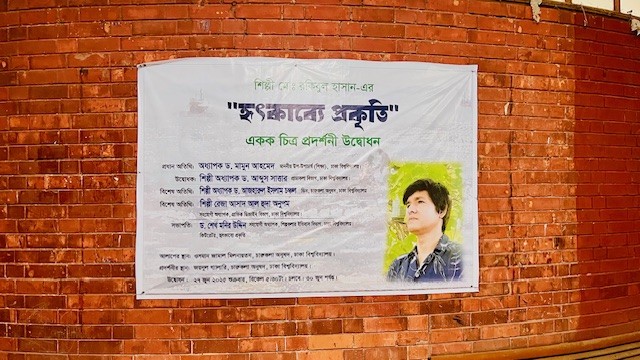
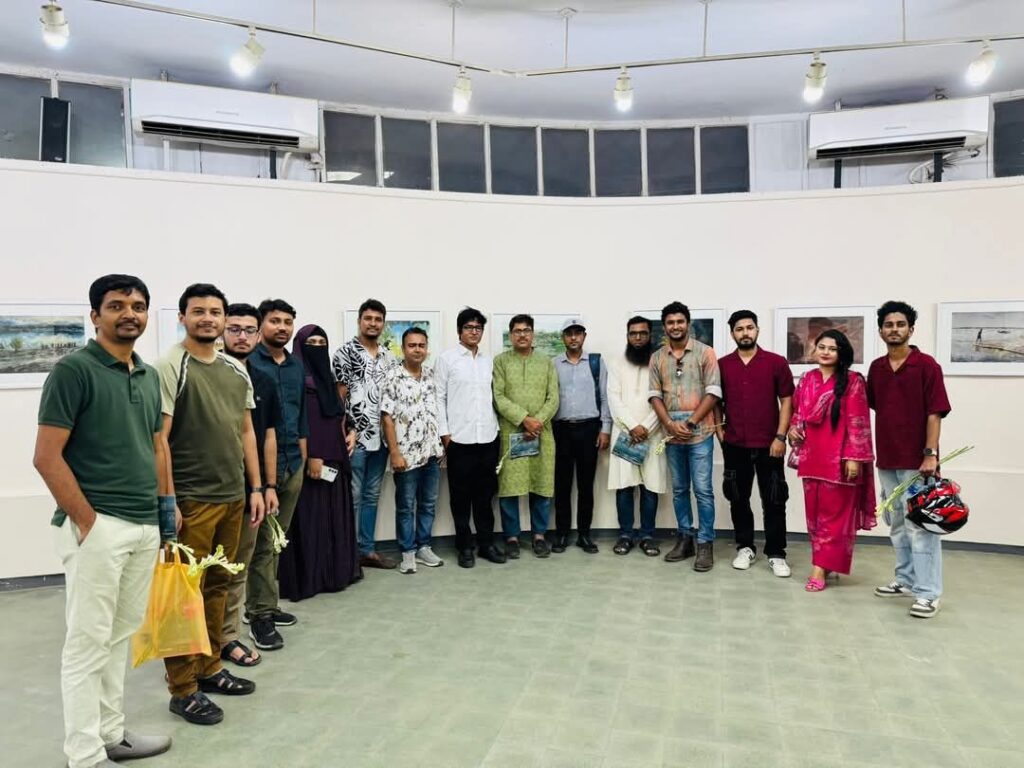
In the heart of Dhaka, at the Zainul Gallery of the Faculty of Fine Arts, University of Dhaka, artist S. M. Rakibul Hasan unveils his solo exhibition titled “HritKabbe Prokriti” reads in English“Nature in the Heart’s Poetry.” This collection is a delicate and heartfelt exploration of nature, rural life, and contemporary realities — all rendered with the luminous transparency of watercolor, one of the most expressive yet demanding mediums in visual art.
Watercolor and Nature: A Soulful Union
Watercolor, with its softness and unpredictability, is a fitting companion to the organic beauty of nature. Rakibul Hasan masterfully uses this medium to breathe life into clouds, rivers, paths, and rural landscapes. In works like Cloud and River, Simple Life, Grazing Land, and Stream, nature is not merely painted — it is felt, absorbed, and gently reflected, inviting the viewer to reconnect with their inner self and surroundings.
What Makes The Exhibition Special
This exhibition stands out not just for its technical excellence, but for its emotional depth. It brings together a series of seventeen watercolor paintings and two acrylic works, each narrating a story of stillness, survival, or subtle resistance and a heartfelt appeal to save nature for saving life. The titles themselves — Bathing, Reflection, Waiting, Buriganga, and Fisherman — hint at a world that moves slowly, yet meaningfully, in harmony with the natural rhythm of life. The use of acrylic in just two pieces (Dragonfly and Graceful) also creates a contrast that highlights the artist’s intentionality in medium selection.
Contemporary Resonance: The Power Struggle
Among the tranquil depictions of nature, one painting starkly reminds us of our current world — Power Struggle. With symbolic and expressive strokes, Rakibul Hasan addresses the global tensions and battles for dominance that threaten both humanity and the environment. This work brings a sharp, relevant edge to an otherwise serene body of work, grounding the exhibition in contemporary reality and expanding its significance beyond aesthetic admiration.
Rural Bangladesh Through Watercolor
The exhibition captures the soul of rural Bangladesh, not through exoticism, but through intimacy and truth. From the quiet footpaths to the life of a fisherman, each image reflects a way of life increasingly endangered by urban expansion and ecological neglect. S. M. Rakibul Hasan’s brushstrokes become a form of cultural preservation, recording sights and emotions that words often fail to hold.
Reconnecting Life and Nature
At the core of this exhibition lies a simple but profound message — life and nature are not separate. By painting nature, the artist is painting fragments of our lives, our memories, and perhaps our futures. The exhibition urges us to remember that nature is not a background, but an integral part of all living creatures including the human being.
If Nature Survives, So Will We
In a time when climate crises loom large and human disconnection from the natural world grows, “Nature in the Heart’s Poetry” becomes more than an art show. It is a gentle call to consciousness, a poetic reminder that saving nature is ultimately about saving ourselves. S.M. Rakibul Hasan’s watercolors serve as visual meditations on this truth — that the heart of life beats in nature, and through art, we are invited to listen.
Taking on the Challenge of Watercolor
Creating art with watercolor is a test of patience, precision, and deep understanding of the medium — and S. M. Rakibul Hasan has boldly embraced this challenge. Unlike other painting techniques, watercolor allows very little room for correction. Its transparency, fast drying time, and fluidity demand a high level of control and spontaneity at the same time. With each brushstroke, the artist must anticipate how water and pigment will interact with paper. Rakibul Hasan’s decision to use watercolor for the majority of his exhibition speaks to both his technical skill and emotional commitment, transforming a difficult medium into a powerful tool for storytelling and connection with nature.
Exposing Environmental Threats: Sand Lifting in Riverways
In one of his striking watercolor paintings, Rakibul Hasan captures the impact of sand lifting, a growing threat to Bangladesh’s natural river systems. Through the subtle yet powerful use of color and form, he portrays how this human activity disrupts the river’s natural flow, endangers aquatic life, and accelerates erosion along riverbanks. The painting serves not just as a work of art but as a visual warning, raising awareness about an often-overlooked environmental issue. By highlighting such concerns through watercolor, Hasan merges aesthetic beauty with urgent ecological advocacy, reminding viewers of the delicate balance between human action and nature’s survival.
A Shared Sensibility with the Artist
In my conversation with S. M. Rakibul Hasan and looking through his emotions in his paintings, I felt a deep resonance — as if his thoughts were echoing my own. His love for nature, his quiet reflections on life, and his simplicity of living are feelings I, too, carry within me. It was not just about understanding his art, but recognizing a shared emotional landscape — a bond formed through mutual sensitivity to the rhythms of nature and the silent poetry of rural life. In his words and his watercolors, I found fragments of my own soul mirrored back, reminding me that art can be a meeting place of kindred spirits.
Exhibition Title: “HritKabbe Prokriti” or “Nature in the Heart’s Poetry.”
Artist: S. M. Rakibul Hasan
Venue: Zainul Gallery, Faculty of Fine Arts, University of Dhaka
Dates: June 27 to June 30, 2025
Time: Daily from 11:30 AM to 5:00 PM
Exhibition Curator: Dr. Sheikh Monir Uddin Jewel, Chairman, Department of Art History, Faculty of Fine Arts, University of Dhaka
-Writer Roton Malo is a freelance journalist and development worker. Currently, he is working at Plan International Bangladesh. Email: rotonmalo@gmail.com